

The boardroom was silent, save for the hum of the HVAC and the soft clicking of the laptop keys by someone who shouldn’t have been emailing during my presentation. I was in my element—the world of medical device innovation. As an Operational Strategic Advisor, my job is to look at a fragmented portfolio of projects, multi-million dollar initiatives, life-saving technologies, and complex global launches, and transform them into a high-performing engine.
In that world, precision is non-negotiable. We build systems not because we love the process, but because we know that a fragmented strategy kills innovation. If the moving parts don’t sync, the product doesn’t launch, the investment is lost, and most importantly, the patients who need that technology are left waiting. The margin for error is thin, and I’ve spent twenty years mastering the art of the “complex build.”
But that afternoon, as I flew back home to my three adventurous, loud, and beautiful boys, a realization hit me with the force of a physical weight.
I was a master of the complex build at work, but I was barely surviving the complex build of my own life.
I could stabilize a global firm’s portfolio, but I couldn’t seem to stabilize a Saturday morning. I could mitigate risks for a medical device launch, but I was constantly blindsided by the “mental load” of running a household. I was treating my career like a high-stakes mission and my personal life like something that just… happened to me.
Here is the truth we talk freely about in the board room yet rarely discuss at home: Fragmentation kill presence.
The Hidden Cost of the “Fragmented” Life
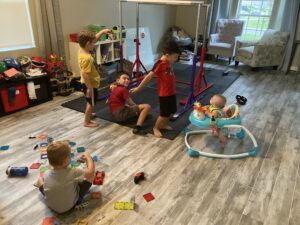 When I talk to moms—whether they are CEOs or stay-at-home heroes—the common thread isn’t a lack of effort. It’s a feeling of fragmentation. We are “multitasking,” which is really just a polite word for “fracturing our attention into a million pieces until none of them get our best.”
In the medical device industry, if a company tries to do twenty things at once without a cohesive strategy, they fail. They lose money, they lose time, and they lose heart. In our homes, the stakes are different but even higher. When our lives are fragmented, when we are answering an email while “playing” Legos, or mentally meal-planning during a bedtime story—we lose the one thing we can never buy back: Presence.
We’ve been told that being a “good mom” means doing it all, all at once, with a smile. But as a strategic advisor, I look at that “plan” and see a recipe for a complete system failure.
We are operating with a thin margin for error, but we aren’t giving ourselves the tools to handle it. We feel stressed not because we are incapable, but because we are trying to run a complex life without an operational foundation. We are managing the chaos, but we aren’t mastering it.
Strategy as a Tool for Peace
 The Chaos Planner wasn’t born from a desire to create more “to-do” lists. Heaven knows we all have enough of those. It was born from a realization that the same strategic principles I use to stabilize multi-million dollar projects can be used to reclaim a Saturday afternoon.
I decided to stop looking at “Operational Strategy” as something that stayed at the office. I started asking: What if I applied “Operational Maturity” to my living room?
Operational Maturity sounds like a cold, corporate term, doesn’t it? But in reality, it is a tool for peace of mind. In business, a mature operation is one that is stable, predictable, and resilient. It can handle a “pivot” because it has a solid foundation.
When I applied this to my life as a mother, the goal shifted. I wasn’t aiming for a life that stayed perfectly within the lines of a project plan. (With three boys, that’s a fantasy anyway!) I was aiming for the resilience to pivot when those lines inevitably blurred.
I realized that if we can design a strategy to withstand the weight of a global market, we can certainly build a personal structure to withstand the weight of reality—the reality of sick kids, changing family units, laundry piles, and the vulnerability of starting over.
Defining Your “True ROI”
In my professional life, ROI (Return on Investment) is usually measured in dollars, market share, or successful regulatory approvals. But as I sat on my kitchen floor one evening, surrounded by the beautiful, messy evidence of a life in progress, I had to redefine the metric for my home.
What is the ROI of a life well-organized?
It isn’t a perfectly labeled pantry (though those are nice). It isn’t a cleared-out inbox. It isn’t even a perfectly followed schedule.
The true ROI is Adventure and Presence.
-
 Adventure: Having the “breathing room” in your life to say “yes” to the spontaneous hike, the messy water balloon fight, or the last-minute road trip because your systems aren’t so fragile that one change breaks them.
 -
Presence: Being exactly where your feet are. When you are with your kids, you are there. When you are working, you are focused. When you are resting, you are actually resting, not scrolling through a mental list of things you forgot to do (or even worse, scrolling the latest social media feed and feeling so guilty about it).
Operational strategy is the “invisible architecture” that makes this possible. It’s the “how” that protects the “why.”
How to Start Bridging the Gap
If you feel buried by the mental load, I want you to know: it’s not your fault, and you don’t need a more expensive planner. You need a shift in strategy. You need to stop being the “project manager” of your chaos and start being the Strategic Advisor of your peace.
Here is the first step in applying operational precision to your living room: 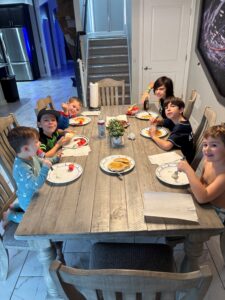
- Identify Your “Fragmented” Areas: Where does your life feel most like a “fragmented portfolio”? Is it the morning routine? The way you handle meal planning? The way your family communicates about the schedule? Pick one area where the “margin for error” feels thinnest, maybe that’s your Saturday morning family time.
- Define the “Product”: In the med-tech world, we always ask: What is the intended use of this device? Ask that about your time. What is the intended use of your Saturday morning? If the intended use is “connection with family,” then any activity that fragments that (like checking work emails or sweeping the floors) is a “defect” in the process.
- Build a Minimum Viable System: Don’t try to overhaul your whole life in a weekend. In strategy, we look for the “Minimum Viable Product”—the simplest version that works. What is the simplest system you can put in place to protect your presence? Maybe it’s a Saturday morning “Phone Basket” where all tech stays until 11am. Maybe it’s a 10-minute “Sync Meeting” with your kids on Friday nights as you snuggle them into bed to plan exactly how you’ll spend your Saturday morning.
- Assess and Improve the System: Try this for one month and just observe—without judgment. What worked? What felt forced? Where did the system break down? In strategy, no system is ever “done.” We review performance, identify friction points, and iterate. Your home systems deserve the same grace. Maybe the phone basket worked, but the timing didn’t. Maybe the Friday night “sync” felt rushed, but the intention was right. Adjust, simplify, and try again.
The goal isn’t perfection—it’s alignment. A system that actually supports the life you’re trying to live, not one that looks good on paper but fails in practice. So, if your system isn’t working, it’s not a personal failure—it’s a design flaw. Fix the system, not yourself.
Standing Steady in the Storm
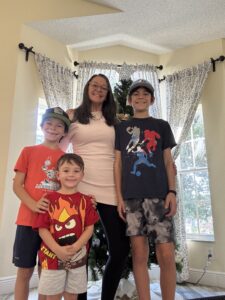 My journey hasn’t been a straight line. I’ve navigated the profound shifts of a changing family unit and the sheer vulnerability of starting over personally. And I’ve also had to rebuild my own “ladder” from the ground up when I decided to start my own business. And through it all, I’ve learned that “success” isn’t about maintaining a perfect facade, it’s living fully in the reality of your own life.
It’s about building a foundation of resilience so that when life gets loud, and it will, you aren’t just surviving the storm. You are standing steady. You have the boundaries and the breathing room to actually enjoy the life you’ve worked so hard to build.
We are all building something complex. We are all navigating high stakes. But we don’t have to do it in a state of constant, fragmented panic.
Let’s stop just managing the chaos. Let’s start mastering it, together. Because your presence is the greatest gift you can give to your people—and to yourself.